
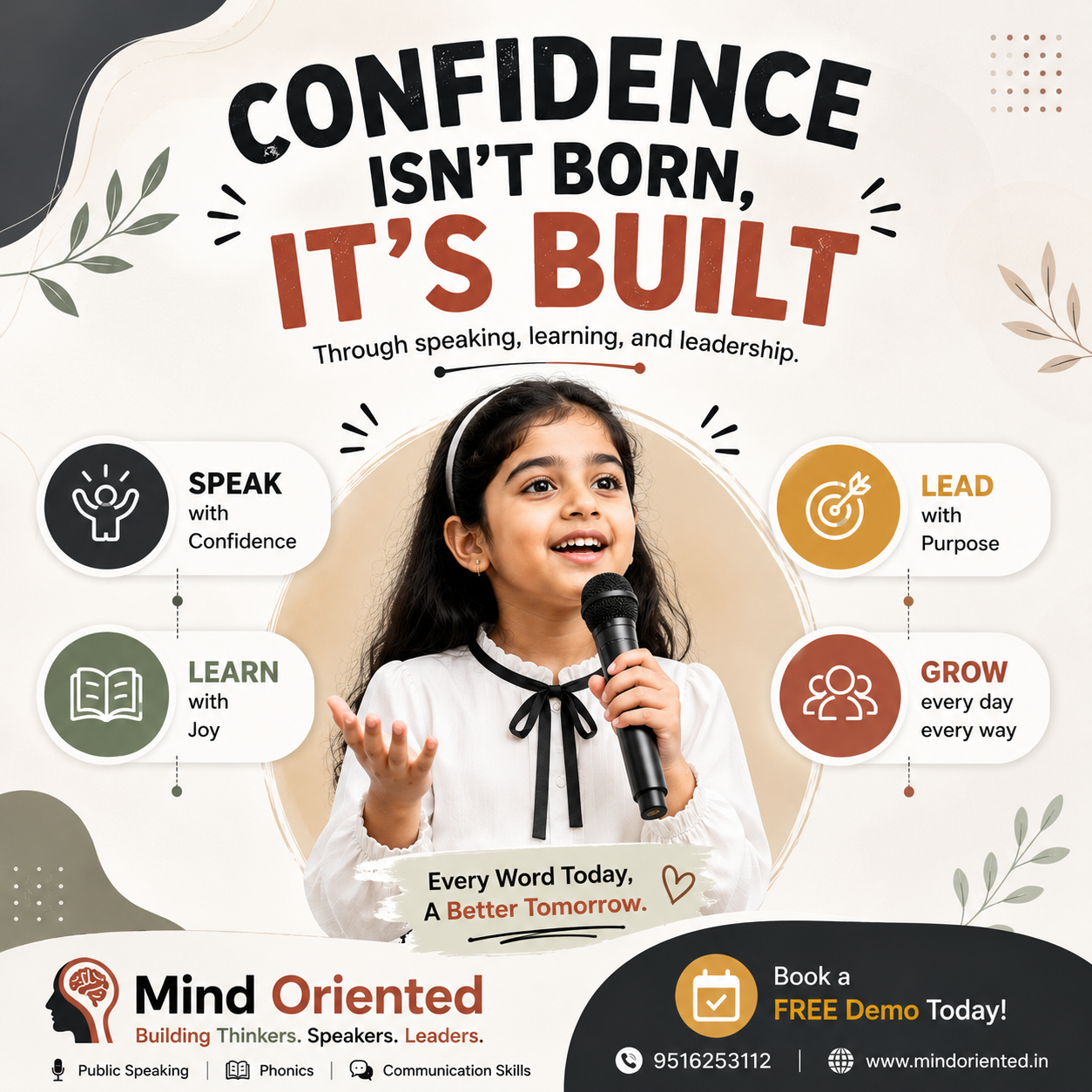
Confidence is one of the greatest gifts a parent can give a child. A confident child is more likely to participate in class, make friends, face challenges, and believe in their own abilities. While every child develops at a different pace, confidence can be nurtured through consistent support, encouragement, and the right learning environment.
At Mind Oriented, we’ve worked with children from India, the USA, Canada, and the Middle East, and we’ve seen firsthand how the right guidance can transform even the shyest child into a confident communicator and learner.Book a Demo
Let’s explore practical ways to help your child build lasting confidence.
Why Confidence Matters
Confidence affects almost every aspect of a child’s life. It influences how they:
- Perform in school
- Interact with peers
- Handle failures
- Express their ideas
- Try new activities
- Solve problems independently
Children who believe in themselves are more willing to learn, explore, and grow.Public Speaking and Personality Developement
1. Encourage Effort, Not Just Results
Instead of saying, “You’re so smart,” try saying:
- “I’m proud of how hard you worked.”
- “You didn’t give up.”
- “Your practice is paying off.”
Praising effort teaches children that success comes from persistence, not perfection.
2. Let Them Make Small Decisions
Giving children age-appropriate choices helps them feel capable and responsible.
For example:
- Choosing their clothes
- Picking a book to read
- Deciding the order of homework
- Selecting an extracurricular activity
Making decisions builds independence and self-belief.
3. Teach Them to Speak Up
Many children know the answer but hesitate to raise their hand.
Encourage your child to:
- Ask questions
- Share opinions
- Introduce themselves confidently
- Participate in discussions
Public speaking activities are an excellent way to develop this habit.
4. Celebrate Small Wins
Confidence grows through small successes.
Celebrate achievements like:
- Reading a new book
- Solving a difficult maths problem
- Speaking confidently in class
- Completing homework independently
Every milestone matters.
5. Don’t Compare Your Child
Every child learns differently.
Comparing siblings, classmates, or friends can reduce motivation and self-esteem.
Instead, compare your child with their own progress:
- “Last month, you were nervous. Today, you spoke confidently.”
This encourages continuous improvement.
6. Help Them Learn from Mistakes
Mistakes are part of learning.
Teach children to ask:
- What went wrong?
- What did I learn?
- What can I do differently next time?
This mindset develops resilience and confidence.
7. Build Communication Skills
Children who communicate well naturally become more confident.
Encourage:
- Storytelling
- Daily conversations
- Reading aloud
- Presentations
- Role-playing activities
The more they practice, the more comfortable they become.
8. Strengthen Academic Foundations
Children often lose confidence when they struggle academically.
Strong fundamentals in:
- Mathematics
- Reading
- English
- Problem-solving
help children feel more prepared and capable in school.
9. Limit Fear of Failure
Avoid expecting perfection.
Let your child know that:
- Everyone makes mistakes.
- Every expert was once a beginner.
- Progress is more important than perfection.
Children who aren’t afraid of failure are willing to try new things.
10. Encourage Reading
Reading improves:
- Vocabulary
- Communication
- Imagination
- Knowledge
- Confidence in speaking and writing
Even 20 minutes of reading every day can make a significant difference.
11. Enroll Them in Skill-Based Learning
Academic education alone isn’t enough.
Courses such as:
- Public Speaking
- Spoken English
- Phonics
- Abacus
- Creative Writing
- Financial Literacy
help children develop practical life skills that boost confidence beyond the classroom.
12. Be Their Biggest Supporter
Children notice your words more than you realize.
Simple statements like:
- “I believe in you.”
- “You can do this.”
- “I’m proud of your effort.”
can leave a lasting positive impact.
A supportive home is where confidence begins.
How Mind Oriented Helps Children Become More Confident
At Mind Oriented, confidence is built into every class.
Our experienced educators create an interactive learning environment where children are encouraged to:
- Speak without fear
- Ask questions freely
- Solve problems independently
- Participate in discussions
- Learn through activities and games
Whether it’s Public Speaking, Spoken English, Mathematics, Phonics, Abacus, Creative Writing, or Financial Literacy, every program is designed to help children grow academically and personally.
Parents often tell us that their children become more expressive, independent, and enthusiastic after just a few weeks of consistent learning.
Final Thoughts
Confidence isn’t something children are born with—it is developed through encouragement, practice, and positive experiences.
As parents, the goal isn’t to make children fearless but to help them believe they can handle challenges, learn from setbacks, and continue growing.
With the right support at home and the right learning environment, every child can discover their potential.
At Mind Oriented, we’re proud to be part of that journey, helping children become confident learners, effective communicators, and future-ready individuals.
Frequently Asked Questions (FAQs)
How can I tell if my child lacks confidence?
Signs may include avoiding new activities, fear of making mistakes, reluctance to speak in class, or giving up easily when faced with challenges.
At what age should confidence-building begin?
Confidence starts developing in early childhood. Positive reinforcement, communication, and age-appropriate responsibilities can help from a young age.
Can online classes improve my child’s confidence?
Yes. Interactive online classes that encourage participation, presentations, and discussions can significantly improve communication and self-confidence.
Which Mind Oriented course is best for confidence building?
Public Speaking and Spoken English are excellent choices, while Phonics, Mathematics, Abacus, and Creative Writing also contribute by helping children master important skills and express themselves confidently.Book a Demo
Keywords
- how to improve child confidence
- confidence building for kids
- parenting tips
- public speaking for children
- communication skills for kids
- spoken English classes
- online learning for kids
- confidence activities for children
- Mind Oriented
- child development
- life skills for kids
- confidence-building classes