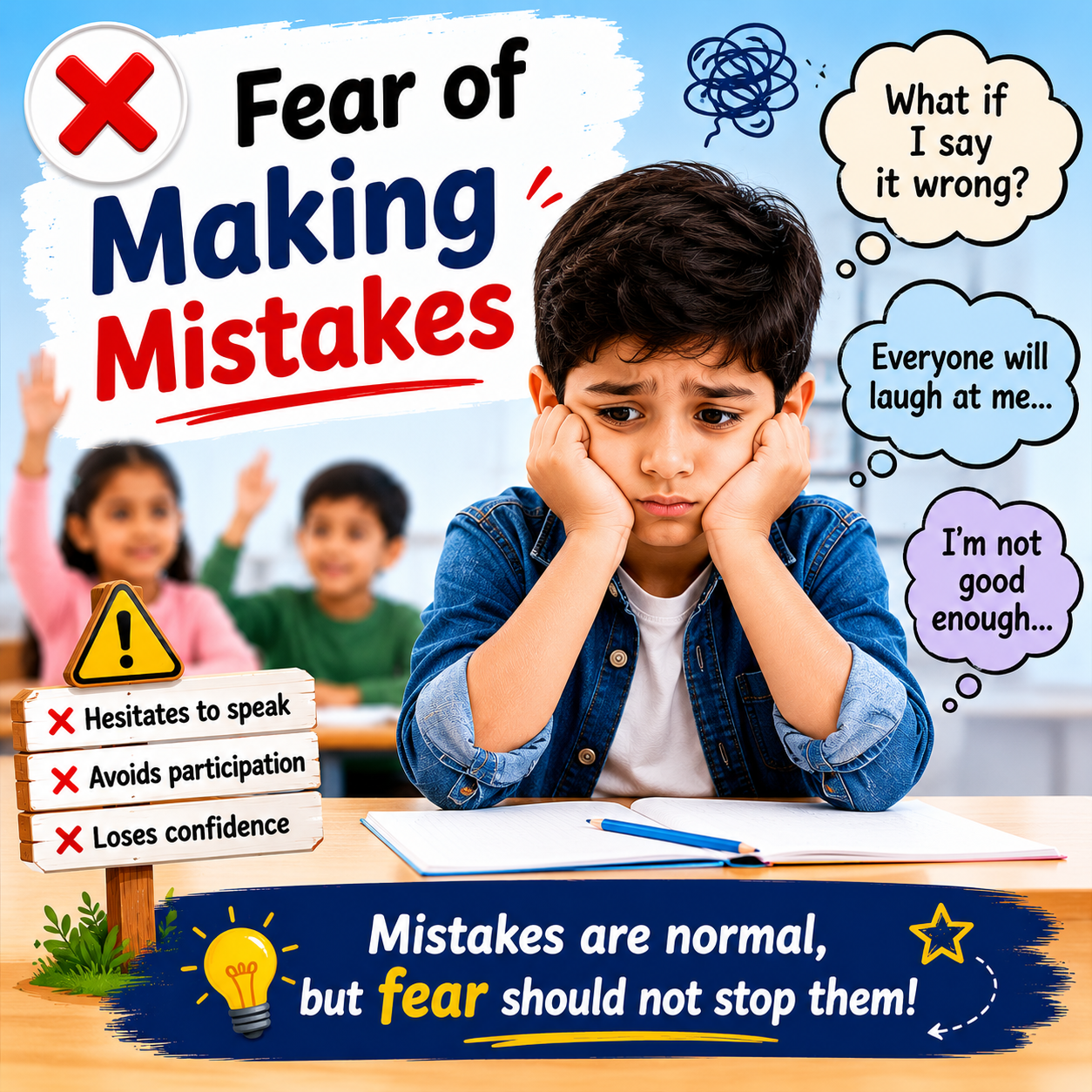
“My Child Knows the Answer… But Won’t Raise Their Hand.”
Your child comes home from school and tells you exactly what happened in class.
They know the lesson.
They understand the homework.
They can explain everything to you at the kitchen table.
But when the teacher asks:
“Who would like to share their answer?”
Silence.Creative Writing
Their hand stays down.
Maybe they worry about saying the wrong thing.
Maybe they don’t like everyone looking at them.
Maybe they simply don’t know how to turn their thoughts into words quickly.
For many parents in the USA, this can be frustrating.
But here’s the important distinction:
A child can be academically capable and still struggle with communication.
That’s why public speaking deserves a place alongside academic learning.All Courses
Why Public Speaking Matters for Kids in the USA
Children today are growing up in a world where communication happens everywhere.
At school.
Online.
In extracurricular activities.
During group projects.
At competitions.
Eventually, in college and the workplace.
Students may be asked to:
- Give classroom presentations
- Explain projects
- Participate in discussions
- Work on group assignments
- Present research
- Participate in debates
- Answer questions
- Give speeches
- Interview for opportunities
- Lead teams
Knowing the answer is valuable.
Being able to explain the answer is a different skill.
Public speaking practice helps children develop that skill.
Public Speaking Is More Than Giving a Speech
When parents hear “public speaking,” they may imagine a child standing on a stage with a microphone.
That’s only one version.
For children, public speaking can mean:
🎤 Giving a two-minute classroom presentation
📚 Explaining a book
🧪 Presenting a science project
🗣️ Sharing an opinion during a class discussion
⚖️ Participating in a debate
📖 Telling a story
💡 Explaining an idea
🎭 Performing a character
⚡ Answering an unexpected question
These everyday speaking opportunities can gradually make communication feel more natural.
7 Signs Your Child Could Benefit From More Speaking Practice
Does your child:
1. Avoid speaking in front of classmates?
2. Speak confidently at home but become quiet at school?
3. Say “I don’t know” even when they know the answer?
4. Become nervous before presentations?
5. Memorize every word of a speech?
6. Speak very quietly when presenting?
7. Struggle to explain their ideas clearly?
None of these automatically means something is wrong.
Children develop at different rates.
But they can be signs that your child would benefit from more opportunities to practice communication in a supportive environment.
The Difference Between Knowing and Communicating
Imagine a fourth-grade student learning about the solar system.
They know:
- The planets
- Their order
- Interesting facts
- The difference between planets and stars
Then the teacher says:
“Tell the class what you learned.”
Suddenly, the child doesn’t know where to begin.
That’s not necessarily a knowledge problem.
It’s an organization problem.
Public speaking teaches children how to transform:
Information → Ideas → Structure → Explanation
For example:
Opening
“Today I’m going to talk about Mars.”
Main idea
“Mars is often called the Red Planet.”
Supporting information
“It appears reddish because of iron-rich material on its surface.”
Conclusion
“That is one reason Mars is one of the most interesting planets to study.”
The child is learning how to communicate knowledge, not just memorize it.
Why Some Kids Freeze During Presentations
Have you ever watched your child practice a presentation perfectly at home?
They sound confident.
They remember everything.
Then presentation day arrives.
They stand in front of the class…
And suddenly:
Nothing.
This can happen because speaking in front of an audience adds pressure.
Children may think:
“Everyone is looking at me.”
“What if I forget?”
“What if I say something wrong?”
“What if someone laughs?”
The answer isn’t always:
“Don’t be nervous.”
Instead, children can learn practical strategies.
Teach Your Child the “Pause, Think, Speak” Method
When your child gets stuck:
1. Pause
Take a breath.
2. Think
Identify the next idea.
3. Speak
Continue with a simple sentence.
A pause isn’t a failure.
In fact, experienced speakers use pauses all the time.
Teach your child that they don’t have to fill every second with words.
10 Public Speaking Activities You Can Try at Home
You don’t need special equipment.
You can start tonight.
1. The One-Minute Challenge
Choose a topic.
Give your child one minute to speak.
Try:
“My favorite place.”
2. Explain It to Me
Ask your child to teach you something.
For example:
“Explain how your favorite video game works.”
3. Picture Story
Show them a picture.
Ask:
“What is happening?”
Then:
“What happened before this?”
And:
“What happens next?”
4. Would You Rather?
Ask:
“Would you rather explore space or the ocean?”
But they must explain why.
5. Hot Seat
Ask five quick questions.
The child answers without preparing.
6. Sell This!
Give them an ordinary object.
A pencil.
A water bottle.
A shoe.
Ask:
“Convince me to buy it.”
7. News Reporter
Ask your child to report a fictional event.
“Breaking news! A dinosaur has been spotted at school!”
Let them explain what happened.
8. Continue the Story
Start:
“When I opened the garage door, I saw…”
Let your child continue.
9. Debate at Dinner
Ask a simple question:
“Should kids have homework every night?”
Your child must choose a side and give two reasons.
10. Teach the Family
Give your child three minutes to teach the family something they know.
The child becomes the teacher.
25 Public Speaking Topics for American Kids
Not every topic needs to be serious.
The best topic is often one that makes a child want to talk.
Try:
- My favorite school subject
- My favorite sport
- My favorite book
- My favorite movie
- My dream job
- My favorite hobby
- If I could invent anything
- If I could have one superpower
- Should students have homework?
- Should kids have smartphones?
- Should school start later?
- What makes a great teacher?
- What makes a good friend?
- Should students wear school uniforms?
- Should kids have more recess?
- Is technology helping students?
- Are video games good for kids?
- Should kids have social media?
- If I were president for a day
- My perfect school
- If animals could talk
- If I could travel anywhere
- What I would change about my community
- Should students have longer summer breaks?
- What makes someone a good leader?
These can be adapted for elementary and middle-school students according to age and maturity.
Public Speaking and Debate: What’s the Difference?
The two skills overlap, but they aren’t identical.
Public Speaking
Focuses on communicating an idea clearly to an audience.
Debate
Adds:
- Arguments
- Evidence
- Counterarguments
- Rebuttals
- Persuasion
For older children, debate can be a fantastic extension of public-speaking practice.
For example:
Topic:
Should schools allow students to use phones during lunch?
A child might learn to:
State an opinion → Give reasons → Provide an example → Respond to another opinion → Conclude
That’s communication and critical thinking working together.
Why Children Shouldn’t Have to Memorize Every Word
Imagine your child has memorized a three-minute presentation.
They get to the second paragraph and forget one sentence.
Suddenly, they panic.
Why?
Because they were depending on exact words.
Instead, teach them to remember key ideas.
For example:
Presentation: My Favorite Animal
Remember:
Animal → Appearance → Habitat → Why I like it → Interesting fact
Now the child can speak naturally.
If they forget one sentence, they haven’t lost the entire presentation.
Public Speaking for Different Ages
Children don’t all need the same type of speaking practice.
Ages 5–7
Focus on:
- Storytelling
- Picture descriptions
- Simple introductions
- Show-and-tell style speaking
- Imaginative topics
Goal:
“I enjoy speaking.”
Ages 8–10
Introduce:
- One-minute speeches
- Presentations
- Opinions
- Storytelling
- Simple debates
- Impromptu questions
Goal:
“I can explain my ideas.”
Ages 11–13
Introduce:
- Structured speeches
- Formal presentations
- Debate
- Persuasion
- Group discussions
- Spontaneous speaking
Goal:
“I can communicate my ideas clearly.”
Teenagers
Focus on:
- Advanced presentations
- Debate
- Interview skills
- Persuasive speaking
- Leadership communication
- Academic presentations
- Impromptu speaking
Goal:
“I can communicate confidently in real-world situations.”
Online Public Speaking Classes for Kids in the USA
For busy families, online learning can make communication practice easier to fit into a weekly schedule.
Children can participate from home while practicing with a teacher and other students.
A strong online public speaking class should not simply be a teacher talking while children watch.
Children need to speak.
Look for classes that include:
✔ Live speaking practice
✔ Presentations
✔ Storytelling
✔ Debates
✔ Group discussions
✔ Impromptu speaking
✔ Individual feedback
✔ Voice and body-language practice
✔ Confidence-building activities
The most important question for parents is:
“How much of the class does my child spend actively communicating?”
Why Online Classes Can Be a Good Option for Families
Online public speaking classes can offer several practical advantages.
No commute
Children can learn from home.
Flexible scheduling
Families can choose classes that fit around school and extracurricular activities.
Regular practice
A weekly class creates a consistent speaking routine.
Interaction
Children can communicate with teachers and peers.
A comfortable environment
Some children who are initially nervous about speaking in person may find it easier to begin practicing from home.
The goal should always be to gradually build confidence rather than create pressure.
How Parents Can Make Public Speaking Less Scary
Here are five simple rules.
Rule #1: Don’t Demand Perfection
A speech doesn’t need to be perfect to be successful.
Rule #2: Let Your Child Finish
Avoid correcting every sentence while they’re speaking.
Rule #3: Praise Specific Improvements
Instead of:
“Good job.”
try:
“I noticed you looked up more while you were speaking today.”
Rule #4: Ask Questions
Help children expand their ideas.
Rule #5: Practice Regularly
Ten minutes several times a week can be more useful than one stressful hour once a month.
A 7-Day Public Speaking Challenge for Your Child
Want to start immediately?
Try this.
Monday
Speak for 30 seconds about a favorite hobby.
Tuesday
Describe a picture.
Wednesday
Tell a one-minute story.
Thursday
Give an opinion and two reasons.
Friday
Answer five questions without preparation.
Saturday
Give a two-minute presentation.
Sunday
Record a speech and watch it together.
Then ask:
“What did you improve?”
Not:
“What did you do wrong?”
That small change can make practice feel much more positive.
The Real Goal Isn’t to Make Your Child Fearless
This is worth remembering.
Even experienced speakers can feel nervous.
Confidence doesn’t mean:
“I never feel nervous.”
Confidence means:
“I can feel nervous and still do it.”
That’s the skill we want children to develop.
A child who once whispered their presentation may eventually speak clearly.
A child who never raised their hand may eventually volunteer.
A child who said:
“I don’t know what to say.”
may eventually say:
“Give me a second. I have an idea.”
That’s progress.
Public Speaking Is a Skill for Life
Your child’s first speech might happen in elementary school.
But the skill doesn’t end there.
Later, they may need to:
- Present a college project
- Participate in a scholarship interview
- Speak during a group project
- Give a presentation at work
- Lead a team
- Pitch an idea
- Interview for a job
- Speak to an audience
- Communicate with people from around the world
The stage may change.
The skill remains.
Give Your Child More Than an Answer
As parents, we spend years helping children learn answers.
But there’s another question worth asking:
“Can my child explain what they know?”
Because knowledge becomes more powerful when a child can communicate it.
Public speaking can help children move from:
“I know.”
to:
“I can explain.”
And eventually:
“I can confidently share my ideas.”
Final Thoughts for Parents in the USA
Your child doesn’t have to become the loudest student in the classroom.
They don’t have to become an extrovert.
They don’t need perfect vocabulary.
And they don’t need to eliminate every nervous feeling.
They simply need opportunities to practice.
Start with a one-minute speech.
Ask a fun question at dinner.
Let them explain their favorite game.
Have a mini debate.
Tell a story.
Give them a chance to teach you something.
Then do it again tomorrow.
Because confidence isn’t built in one giant moment.
It’s built through hundreds of small moments when a child gets to speak and realizes:
“People are listening.”
“My ideas matter.”
“I can do this.”
And eventually…
“I have something to say — and I’m ready to say it.”
Frequently Asked Questions
What is the best age to start public speaking for kids?
Children can begin with simple storytelling, picture descriptions and short conversations at a young age. Activities should become more structured as children grow.
What are the best public speaking classes for kids in the USA?
Look for live programs that provide substantial speaking time, personalized feedback, presentations, storytelling, debate, impromptu speaking and confidence-building activities.
Can shy children benefit from public speaking classes?
Yes. A supportive class can give shy children regular opportunities to speak in a structured environment. Activities should progress gradually rather than forcing children into uncomfortable situations immediately.
How can I help my child become more confident?
Start with short, low-pressure speaking activities at home. Celebrate improvement, avoid excessive correction and gradually increase the difficulty.
How long should children practice public speaking?
Start with approximately 5–10 minutes and increase gradually as your child becomes more comfortable.
Is online public speaking effective for children?
Live online classes can be effective when children actively participate, interact with instructors and peers, and receive meaningful feedback.
Does public speaking help with school presentations?
Yes. Practicing organization, speaking, body language, storytelling and spontaneous responses can help children become more comfortable with classroom presentations.
Ready to Help Your Child Find Their Voice?
Your child doesn’t need to wait until high school, college or a job interview to learn how to communicate confidently.
Start now.Book a Demo
Give them a safe place to practice.
Give them interesting questions.
Give them opportunities to speak.
And most importantly:Public Speaking and Personality Developement
Give them someone who will listen.
Mind Oriented — Online Public Speaking for Kids
Learn. Think. Speak. Grow.Book a Demo
public speaking for kids USA
Secondary Keywords: public speaking classes for kids USA, online public speaking classes for kids, kids public speaking classes, public speaking for children, communication skills for kids, speech classes for kids, confidence classes for kids, debate classes for kids