
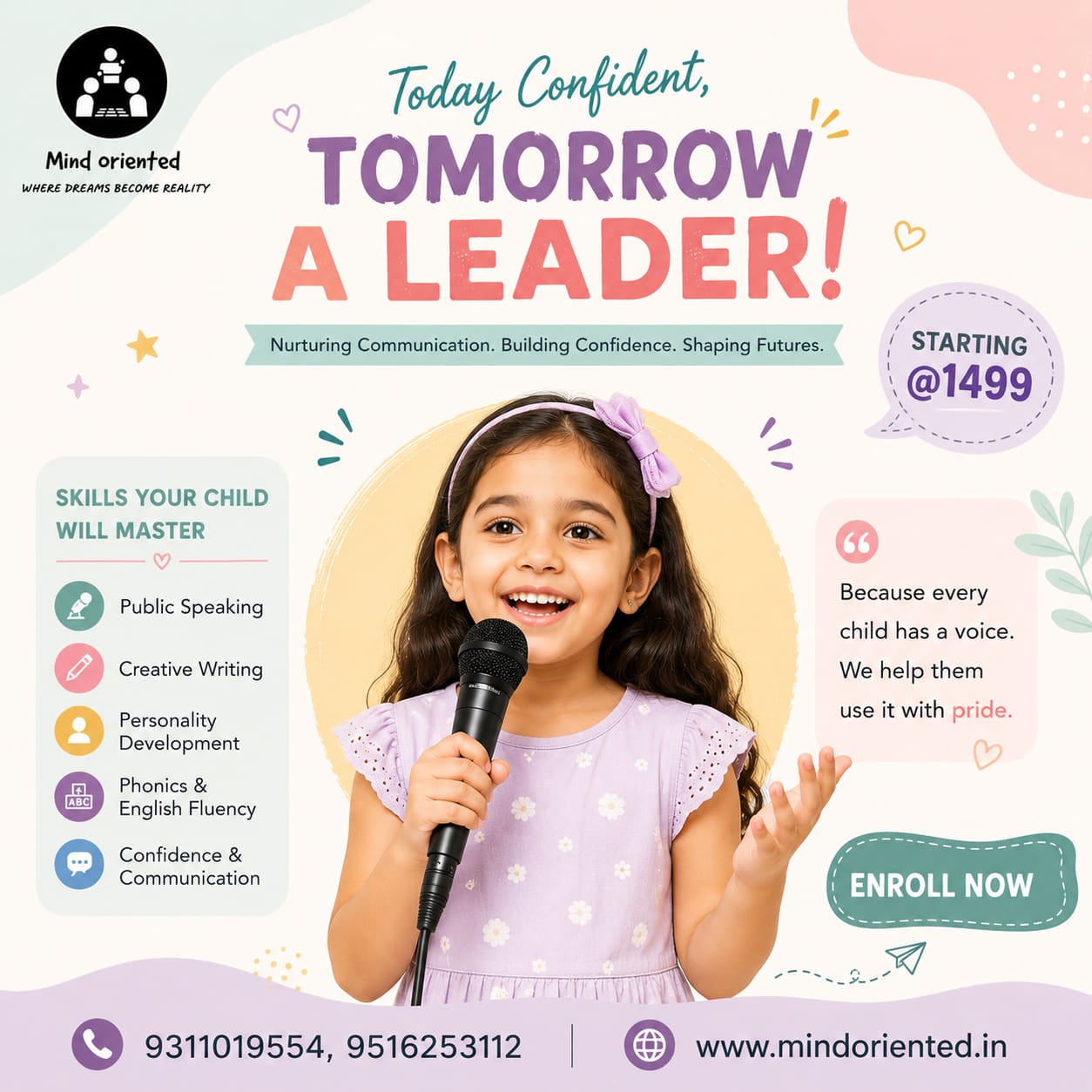
Public Speaking Is No Longer Just a School Skill
A child who can confidently stand up and speak is developing much more than the ability to give a speech.
They are learning how to express ideas, communicate clearly, think independently, handle questions, participate in discussions, and connect with other people.
In today’s increasingly global world, communication has become one of the most valuable skills a child can develop.
Whether a student lives in the USA, Canada, the UK, Australia, UAE, India, Singapore, or anywhere else, the ability to communicate confidently can support them in school, competitions, interviews, university applications, and eventually their professional lives.
Academic knowledge matters. But knowing how to communicate that knowledge matters too.Book a Demo
What Is Public Speaking for Children?
Public speaking is the ability to communicate thoughts and ideas to an audience in a clear, organized, and confident way.
For children, it can include:
- Classroom presentations
- Storytelling
- Debates
- Group discussions
- Speeches
- Show-and-tell
- Elocution
- Extempore speaking
- Model United Nations
- Competitions
- Interviews
- Leadership activitiesPublic Speaking and Personality Developement
Public speaking doesn’t mean every child needs to become an entertainer or professional speaker.
Instead, it helps children become better communicators.
Why Is Public Speaking Important for Kids?
1. It Builds Confidence
One of the biggest benefits of public speaking is increased confidence.
A child who initially struggles to speak in front of others can gradually learn to:
Think → Organize → Speak → Respond → Improve
With regular practice, speaking in front of an audience becomes less intimidating.
This confidence can extend beyond the classroom.
A confident child may feel more comfortable:Book a Demo
- Asking questions
- Answering teachers
- Participating in group activities
- Meeting new people
- Sharing opinions
- Taking leadership roles
2. It Improves Communication Skills
Being able to communicate effectively is different from simply knowing the right answer.
Children need to learn how to explain what they know.
Public speaking helps them develop:
- Vocabulary
- Sentence formation
- Pronunciation
- Voice modulationBook a Demo
- Listening skills
- Storytelling
- Clarity of thought
- Conversational skills
These abilities can benefit children academically and socially.
3. It Teaches Children How to Organize Their Thoughts
Imagine asking a child:
“What do you think about artificial intelligence?”
A child may have many ideas but struggle to explain them.
Public speaking teaches children to structure their thoughts.
A simple framework can be:Creative Writing
Opening → Main Idea → Supporting Points → Example → Conclusion
Once children understand how to organize information, they can apply the same skill to school presentations, essays, projects, and conversations.
4. It Encourages Critical Thinking
Good speakers don’t simply memorize sentences.
They learn to think.
Debates and discussions can encourage children to:
- Look at different perspectives
- Give reasons for their opinions
- Support arguments with examples
- Listen to opposing viewpoints
- Respond to questions
- Think quicklyPublic Speaking and Personality Developement
This makes public speaking closely connected with critical thinking and problem-solving.
5. It Helps Children Express Their Opinions
Children have opinions.
The challenge is helping them express those opinions respectfully and clearly.
Public speaking provides a structured environment where children can learn:
“I have an idea, and I can explain why I think this way.”
This can be particularly valuable as children grow older and become more independent thinkers.
Public Speaking and Academic Success
Public speaking isn’t separate from academics.
Students are increasingly expected to present projects, participate in discussions, explain solutions, work in teams, and communicate their understanding.
For example, a student may know how to solve a mathematics problem but struggle to explain their process.
Another student may understand a science topic but feel nervous when presenting it.
Public speaking practice can help bridge that gap.
Knowledge + Communication = Stronger Academic Expression
Why Public Speaking Matters in a Global Classroom
Children today are growing up in a world where communication increasingly crosses borders.
A student in Canada may collaborate with someone in the United States.
A student in India may attend university in the UK.
A student in Dubai may work with colleagues from several countries.
A student in Australia may participate in international competitions or online communities.
This makes communication skills increasingly important.
Children don’t just need to communicate with people who share their background.
They may eventually communicate with people from different cultures, countries, languages, and perspectives.
Online Public Speaking Classes for Kids
Technology has made it possible for children to learn public speaking from almost anywhere.
Online classes can provide:
- Live interaction with teachers
- Individual speaking practice
- Presentation activities
- Debate sessions
- Storytelling exercises
- Group discussions
- Personalized feedback
- Flexible scheduling
For families with busy schedules, online learning can also eliminate travel time.
A child can participate in a live class from home while still receiving structured instruction and feedback.
How Can Parents Help Children Practice Public Speaking at Home?
Parents don’t need to create complicated activities.
Start small.
Try the 60-Second Speaking Challenge
Give your child a topic such as:
“If I could invent anything…”
Ask them to speak for one minute.
Don’t interrupt.
Afterward, ask:
- What was your main idea?
- What example did you give?
- What could make your answer even better?
Other topics could include:
- My dream school
- If I could travel anywhere
- My favorite invention
- Should homework be optional?
- One problem I would solve
- My favorite book
- If animals could talk
The goal isn’t perfection.
The goal is practice.
Public Speaking Skills Children Should Develop
A strong public speaking program should go beyond memorizing speeches.
Children can gradually develop:
🎤 Voice
Volume, pace, tone, and expression.
👀 Eye Contact
Learning to connect with an audience.
🧍 Body Language
Posture, gestures, facial expressions, and movement.
🧠 Organization
Learning how to structure ideas logically.
💬 Vocabulary
Using age-appropriate and effective language.
⚡ Spontaneous Speaking
Thinking and responding without extensive preparation.
🤝 Listening
Understanding what others are saying before responding.
🎯 Persuasion
Learning how to support an opinion with reasons and examples.
At What Age Should Children Start Public Speaking?
There is no single “perfect” age.
Younger children can begin with:
- Storytelling
- Show-and-tell
- Simple conversations
- Picture descriptions
- Short presentations
Older children can progress toward:
- Debates
- Speeches
- Group discussions
- Presentations
- Extempore speaking
- Leadership activities
- Competition preparation
The important thing is to make activities age-appropriate and enjoyable.
Public Speaking Should Not Be About Memorization
One common mistake is asking children to memorize an entire speech word-for-word.
Memorization can help in some situations, but children also need to learn how to think while speaking.
Instead of only asking:
“Can you remember your speech?”
encourage questions like:
“What is your main point?”
“Why do you believe that?”
“Can you give me an example?”
“What would you say if someone disagreed with you?”
These questions help develop authentic communication.
From Shy Speaker to Confident Communicator
A shy child doesn’t necessarily lack ideas.
Sometimes they simply need a safe environment in which to practice.
A good learning journey might look like:
Stage 1: Speak one-on-one
↓
Stage 2: Speak in a small group
↓
Stage 3: Give a short presentation
↓
Stage 4: Participate in discussions
↓
Stage 5: Debate and defend opinions
↓
Stage 6: Speak confidently to larger audiences
Progress doesn’t happen overnight.
But consistent practice can make speaking feel increasingly natural.
How Parents Can Choose the Right Public Speaking Class
If you’re considering online public speaking classes for your child, look for a program that provides more than lectures.
Consider whether the class includes:
✅ Live speaking practice
✅ Personalized feedback
✅ Small-group interaction
✅ Debate and discussion
✅ Presentation practice
✅ Storytelling
✅ Impromptu speaking
✅ Confidence-building activities
✅ Age-appropriate topics
✅ Regular opportunities to speak
The most important question is:
How much does my child actually get to speak?
Because public speaking is a skill that improves through doing, not just watching.
The Future Belongs to Children Who Can Communicate
Academic qualifications can open doors.
Communication skills can help children walk through them.
As education and careers become increasingly international, children may need to communicate across classrooms, cultures, countries, and digital platforms.
Teaching public speaking early can therefore be an investment in more than school performance.
It can help children develop the confidence to say:
“I have an idea.”
“I have an opinion.”
“I can explain it.”
“And I’m confident enough to share it.”
Final Thoughts
Public speaking is not about creating children who are loud.
It’s about helping children become clear, confident, thoughtful, and effective communicators.
Whether your child is naturally outgoing or prefers to stay quiet, public speaking practice can provide valuable opportunities to develop confidence, communication, critical thinking, leadership, and self-expression.
And in a world that is becoming more connected every day, these are skills that can travel with them anywhere in the world.
Give your child the confidence to speak today — because their ideas deserve to be heard.Book a Demo
public speaking for kids kids public speaking classes, online public speaking classes for children, communication skills for kids, confidence building for children, public speaking classes online, speech classes for kids, global communication skills