
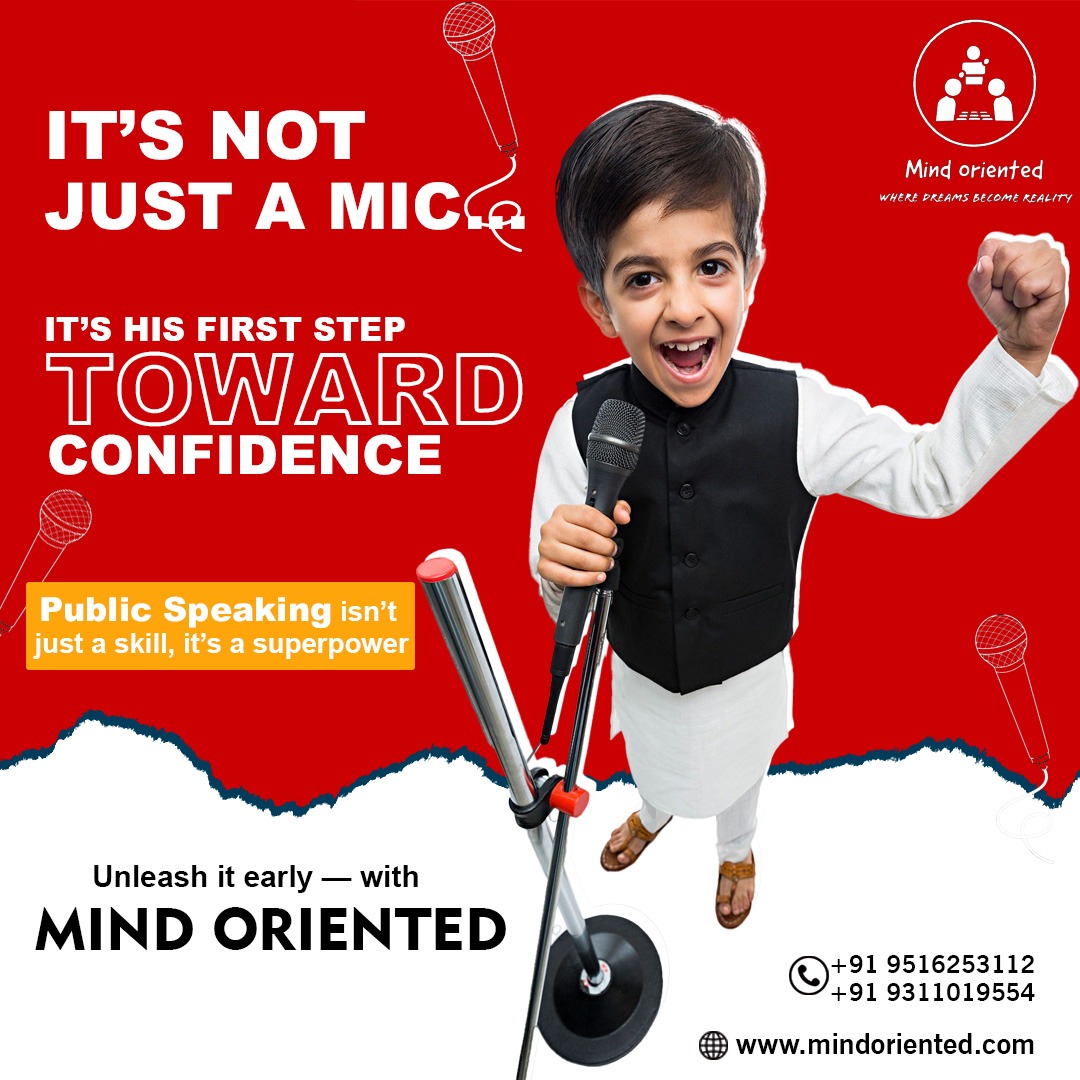
“What Do You Think?”
It’s only three words.
But how often do we actually ask children this question?
We ask:
“Did you finish your homework?”
“What marks did you get?”
“Did you study for tomorrow’s test?”
“Did you eat?”
But how often do we stop and ask:
“What do you think?”
For many Indian children, most conversations are about giving the right answer.
School rewards correct answers.
Examinations reward correct answers.
Homework rewards completed answers.
But real life often asks something completely different:
“What’s your opinion?”
And that’s where communication skills become important.
A Child Can Memorise an Answer Without Learning to Express an Idea
Imagine asking a child:
“What is your favourite subject?”
They answer:
“Science.”
Now ask:
“Why?”
Suddenly, they pause.
Maybe they know why.
But they haven’t practised explaining their thoughts.
Now ask:
“What would you change about your school if you could?”
There is no textbook answer.
There is no memorised paragraph.
The child has to:
Think → Form an opinion → Organise the thought → Speak.
That is public speaking at its most basic level.
And it starts long before a child stands on a stage.
Why Opinion-Based Speaking Matters
A strong communicator isn’t simply someone who speaks loudly.
A strong communicator can:
- Form an opinion
- Explain their reasoning
- Give examples
- Listen to another viewpoint
- Ask questions
- Respond thoughtfully
- Change their mind when presented with new information
- Disagree respectfully
These are communication skills children can begin developing from a young age.
And they don’t require complicated lessons.
They require practice.
The “Correct Answer” Culture
Academic success is important.
But if children become afraid of saying something that isn’t perfect, they may stop participating.
A child might think:
“What if my answer is wrong?”
So they don’t answer.
Then:
“What if my English isn’t perfect?”
So they don’t speak.
Then:
“What if everyone laughs?”
So they stay quiet.
Over time, silence can become comfortable.
And speaking can become uncomfortable.
This is why children need environments where they understand:
A mistake is not a failure.
It’s part of learning.
Try This 60-Second Challenge With Your Child
Tonight, give your child this topic:
“Should children have homework on weekends?”
Give them 30 seconds to think.
Then ask them to speak for one minute.
Don’t interrupt.
Don’t correct them.
Just listen.
After they finish, ask:
“Why do you think that?”
Then:
“Can you give me an example?”
Finally:
“What would someone who disagrees with you say?”
Congratulations.
You’ve just practised:
- Public speaking
- Critical thinking
- Reasoning
- Listening
- Spontaneous speaking
- Confidence
All from one question.
Why Some Children Speak Freely at Home but Not Outside
Home is usually a child’s safest environment.
They know the people listening.
They know they won’t be laughed at for getting something wrong.
They don’t have to worry about being judged by classmates.
Outside the home, the stakes can feel much higher.
That’s why a child who talks continuously at dinner may become extremely quiet during a school presentation.
They aren’t necessarily lacking personality.
They may simply need more structured speaking practice.
Public Speaking Shouldn’t Begin With a Stage
For a nervous child, starting with a five-minute speech can be overwhelming.
Instead, build gradually.
Start With Questions
“What was the funniest thing that happened today?”
Move to Opinions
“Which is better: summer or winter?”
Add Reasons
“Why?”
Add Examples
“Can you give me an example?”
Introduce Storytelling
“Tell me what happened from beginning to end.”
Add Impromptu Speaking
“Pick one object in the room and speak about it for 30 seconds.”
Finally, Introduce Presentations
Now the child has already developed the basic speaking muscles.
What Children Should Learn in Public Speaking Classes
A good public speaking class for kids shouldn’t simply teach children how to memorise speeches.
It should help them develop several connected skills.
Speaking Clearly
Children learn to communicate their message so that others can understand it.
Storytelling
They learn how to create a beginning, middle and end.
Voice Modulation
They practise pace, tone, pauses and volume.
Body Language
They learn how posture, facial expressions and gestures affect communication.
Impromptu Speaking
They practise thinking and speaking without a prepared script.
Opinion Building
They learn how to state an opinion and support it with reasons.
Presentation Skills
They learn how to organise information before presenting it.
Listening
They learn that communication works both ways.
Why Online Classes Can Make Speaking Practice Easier
For Indian families managing school, tuition, sports and extracurricular activities, online learning can provide a convenient way to add communication practice to a child’s routine.
But the class needs to be interactive.
If a child spends 60 minutes watching a teacher speak, that’s not a public-speaking class.
A meaningful session should look more like:
Teacher asks → Child thinks → Child speaks → Teacher gives feedback → Child tries again.
The child should spend a significant part of the session using their voice.
How Parents Can Choose the Right Program
Before enrolling your child, ask:
How much will my child speak during each class?
Are classes live and interactive?
Will the teacher give individual feedback?
Does the program include spontaneous speaking?
Will my child practise presentations?
Are storytelling and opinion-based activities included?
Is the program suitable for my child’s age?
How will progress be measured?
These questions can help you look beyond advertisements and understand what your child will actually experience.
What If Your Child’s English Isn’t Perfect?
Don’t wait for perfect English before encouraging your child to speak.
Communication confidence grows through use.
Children need to feel comfortable:
Speaking → Making mistakes → Receiving feedback → Trying again.
If every sentence is immediately interrupted and corrected, some children become more focused on avoiding mistakes than expressing ideas.
The better approach is often:
Let them finish.
Then:
Help them improve.
The Skill That Can Follow Your Child for Decades
Think beyond school.
One day your child may need to:
- Give a college presentation
- Participate in an interview
- Explain an idea
- Lead a project
- Participate in a debate
- Speak to a new group
- Present a business idea
- Handle a professional meeting
- Express disagreement respectfully
Nobody can predict exactly what career a child will choose.
But communication will almost certainly matter.
How Mind Oriented Helps Children Develop Their Voice
At Mind Oriented, public speaking is treated as an active skill.
Children can practise:
- Storytelling
- Impromptu speaking
- Presentations
- Opinion-based discussions
- Role play
- Speech delivery
- Voice modulation
- Body language
- Question-and-answer activities
- Confidence-building exercises
The objective isn’t to make every child sound like a professional speaker.
It’s to help children become comfortable saying:
“This is what I think.”
And then confidently explaining:
“This is why.”Creative Writing
The Most Powerful Question You Can Ask Your Child Today
Not:
“Did you get good marks?”
Not:
“Did you finish your homework?”
Instead, ask:Book a Demo
“What do YOU think?”
Then listen.
Don’t correct.
Don’t rush.
Don’t give them the answer.
Give them a moment to think.
Because when children learn that their thoughts are worth listening to, they begin to understand something powerful:
Their voice matters.Public Speaking and Personality Developement
Your Child Doesn’t Need to Become the Loudest Person in the Room
They simply need to feel comfortable enough to speak when it matters.
To ask a question.
To share an idea.
To explain an opinion.
To make a presentation.
To introduce themselves.
To say:
“I disagree, and here’s why.”
That is confidence.
And confidence isn’t something children have to be born with.
It can be practised.
It can be developed.
It can grow.Academics
Ready to Help Your Child Become a More Confident Communicator?
Give your child a safe and engaging environment to practise speaking, thinking and expressing ideas.
Book a FREE Trial Public Speaking Class with Mind Oriented.
Mind Oriented
Think. Speak. Express. Grow.Book a Demo
online public speaking classes for kidscommunication skills for kidsopinion speaking for childrenconfidence classes for kidspublic speaking course Indiaonline communication classes for childrencritical thinking and public speakingpresentation skills for kidsspeaking skills for childrenpersonality development for kids